On a city marathon, you're never really alone with the distance. Every kilometer is marked. Your watch reads about 5:40 per kilometer — which means you're currently on pace for roughly a four-hour finish. It reads 6:10 — also clear: you're behind, so decide what to do about it. There's a pacer running next to you with a balloon, their target time printed on their back. The whole race comes down to one question with a known answer: are you holding pace or not.
Now picture a different scene. Six hours into a mountain race. A climb, and past the crest, another climb. No kilometer markers, no pacers. You haven't seen another runner in a while. Your watch shows 9:24 per kilometer — and that number doesn't mean anything on its own. Is that slow? Is it fine? Without a reference point set in advance, you have no way of knowing whether this pace makes sense for this slope, at this point in the race. And there's nobody to ask — there's nobody around at all.
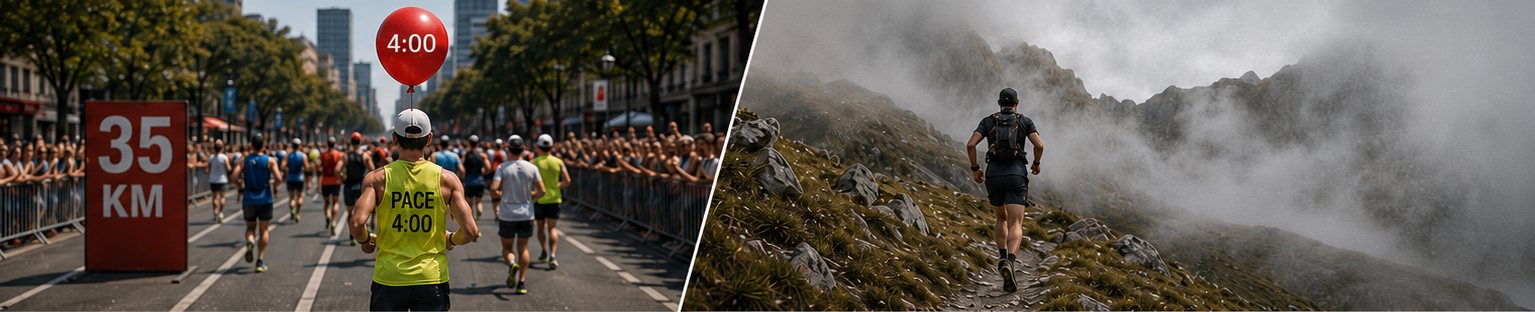
There's a second difference that gets written about far less than elevation gain. The leaders get filmed, spectators line their route, their splits get discussed live. An amateur on that same course spends ten, fifteen, twenty hours alone. On a long ultra-trail, an amateur can be out there for more than a full day, spending much of that time without any external reference points or support.
It's exactly in those long hours, when there's almost no external reference point, that a race often starts to fall apart. Not at the crowded start, not on the final kilometer — but somewhere in between, where you're running on your usual feel for pace, and that feel is letting you down here.
01Why average pace is meaningless on trail
On a flat marathon, one kilometer is similar enough to the next that the whole plan can be reduced to a single number. On trail, adjacent kilometers can demand completely different amounts of effort.
The energy cost of movement really does change a great deal with grade. Italian physiologist Alberto Minetti and colleagues put test subjects on an inclined treadmill at slopes from −45% to +45% and calculated the cost of every meter of ground covered. The difference turns out to be very large. The energy cost of walking on flat ground is about 1.64 J·kg⁻¹·m⁻¹; for convenience, we'll just call this the cost per meter from here on, keeping in mind that it's normalized to body mass. The cost per meter of walking up a 45% slope is 17.33. More than ten times as much. This isn't just a subjective impression: the energy cost of movement genuinely rises that sharply.

And in that same data is a fact that turns intuition on its head. In the experiment, the lowest energy cost of running wasn't observed on flat ground, but on a moderate descent. Running on level ground costs 3.40, while running down a −20% grade costs just 1.73 (same units). Half the price. In terms of energy consumption, a moderate descent can be noticeably more economical than running on the flat.
So why is everyone so cautious on descents? The study's own authors noticed this: the theoretical top speeds for downhill running came out well above what runners actually hit in real races — unlike on climbs, where the calculation and reality lined up. That means energy cost doesn't fully explain downhill speed. Among the likely limiters are eccentric muscle loading, technique, footing, and a runner's own caution. (More on that in a separate article.)
Put these facts together: energy cost changes with grade, grade keeps changing throughout the course, and descents bring in additional limiters of their own. One number cannot describe a race like that.
02What a plan actually is
Cut the course into its natural pieces: this climb, this descent, this flat stretch along the river. Ronda 101 breaks into 45 such pieces over 104 kilometers. For each segment, you need to work out three realistic parameters in advance:

What pace? Not "as fast as I can while I'm still fresh," but specifically: this +8% grind at kilometer 34 — 10:50 per kilometer, not a sign of failure, but a realistic target pace for this climb.
Run or hike? The steeper the slope, the smaller running's advantage over a brisk power-hike — and the more running costs, while a fast hike can end up noticeably cheaper. The crossover point is individual: it depends on gradient, speed, training, and fatigue — it comes earlier for one runner, later for another. It's better to make this call in advance, in a calm state of mind, rather than on the slope, caught up in the moment and the urge to keep running at any cost.
How long at aid stations? Three minutes at a stop is three minutes. Stop at all twenty of Ronda 101's aid stations for three minutes on average, and that adds up to a full hour — one that doesn't show up in your average pace but does show up in reality. A plan that ignores stops is lying to you by exactly that hour.
And once all of this is worked out, your watch starts to mean something. 9:24 per kilometer is no longer an empty number: you know the plan for this climb is 9:40, you know how much of it is left to the top, which segment comes next, how much effort you can spend there, and what time you'll finish if this keeps up. Whether you're ahead of the plan or behind it is secondary. What matters is that, even on a remote stretch of the course, you still have a clear reference point.
03Why a rough patch doesn't always end in a DNF
This calls for some care, because the topic attracts a lot of language that sounds good but says little.
Ask people who dropped out why they dropped, and they'll give you physical reasons. In the largest survey of hundred-mile races — Western States and Vermont 100 — the number-one cause among non-finishers is nausea and vomiting: 23%. Not "broke mentally." Nausea.
But some studies look past the explanations, at what actually distinguished finishers from those who dropped out. And there, the picture changes.
Swiss researchers analyzed the subjective experience of finishers and non-finishers, drawing on detailed retrospective interviews and published race reports. Everyone went through rough patches — finishers and non-finishers alike. The difference was what happened next. The researchers classified these rough episodes of exhaustion, pain, and loss of control as a state of reduced vitality. Following such episodes, 66% of finishers' episodes were followed by a return to a stable, functional state; for non-finishers, only 40% were. And for 90% of those who dropped out, the last state they described stayed a state of loss, with no return. In other words, in dropouts' accounts, the final rough patch more often was never followed by recovery.
Another study followed 221 participants in a 140-kilometer ultra-trail race. A model built on experience plus a set of psychosocial measures taken before the start was statistically associated with the likelihood of dropping out, explaining a meaningful but far from complete share of the variation between participants (36.4% of the variance); among the factors linked to a lower risk of dropping out were self-confidence, a firm intention to finish, and active coping strategies.
The honest takeaway is this. It's not true that "people drop out because of their head, not their legs" — people drop out because they're nauseous, because a knee hurts, because they've run out of strength. The truth is subtler: rough patches happen to everyone, but some people climb out of them and some don't. A physical problem often triggers the crisis, while experience, confidence, and coping strategies can influence whether an athlete manages to keep going.
04What a plan does to your head
A direct study — take a hundred runners, hand half of them a written plan, give the other half nothing, and compare dropout rates — doesn't exist. We didn't find one, so what follows is a plausible hypothesis, not a proven effect.
But there's a foundation underneath the reasoning. On trail, you can't fully rely on the pace instinct you built on the road. That follows from Minetti's numbers: the same effort produces a completely different pace depending on the grade. The instinct for gauging pace by feel, built up on flat ground, becomes unreliable in the mountains. Constant switching — up, down, run, hike, stop at an aid station — only makes it worse: it gets harder and harder to tell, from feel alone, whether you're racing fast or slow. On the road, your current pace is easy to compare against your overall target. In the mountains, you first have to relate it to the grade, the type of terrain, and where you are in the race.
A decision made in advance is often easier to execute than one invented on the fly. There's little direct research on trail pacing specifically here, so, honestly: this is a plausible mechanism, not a proven effect. But some things are known. Finishers in the Swiss study were more likely to recover their footing after a rough patch and return to a stable state. That study didn't test segmented plans. Still, we suspect that reference points set in advance may reduce the uncertainty that follows a rough patch — that hypothesis still needs to be tested separately. Reaction time and attention do measurably worsen after races like this: UTMB finishers, who rested a total of about 12 minutes across the entire race, already showed lower scores on those measures by the finish. Cognitive fatigue likely builds up over the course of the race too, so decisions made in advance may reduce the load on attention — though the direct effect of plans on finish rates hasn't been studied.
And you're alone. An amateur doesn't have a crew to feed them, pull them together, and tell them what to do at each aid station — it's all on you. It's easier to stay composed when some of the decisions are already made, and the current segment's plan is always visible on your watch screen.
A plan gives you an external reference point. One glance at your wrist: on this segment, you're 4 minutes behind schedule. That's not a race falling apart — it's a number you can work with: you'll make some of it back somewhere, adjust the goal somewhere else, but the race is still yours, it still has a shape and a next step.
Falling behind the plan, on its own, doesn't mean the race has fallen apart — falling behind is normal and happens often. What matters is that uncertainty has turned into a specific, workable gap, and a hundred-kilometer race has turned into one understandable climb happening right now: the watch removes the need to keep re-deciding what to do next, over and over. And if you do fall behind, this race's data will make your next plan more accurate. A plan captures the decisions made in advance, in a calm state of mind. During the race, you use it as a starting point, adjusting for weather, how you feel, and the actual conditions on the day: you don't have to make every decision from scratch — the plan is a foundation you adjust as needed.
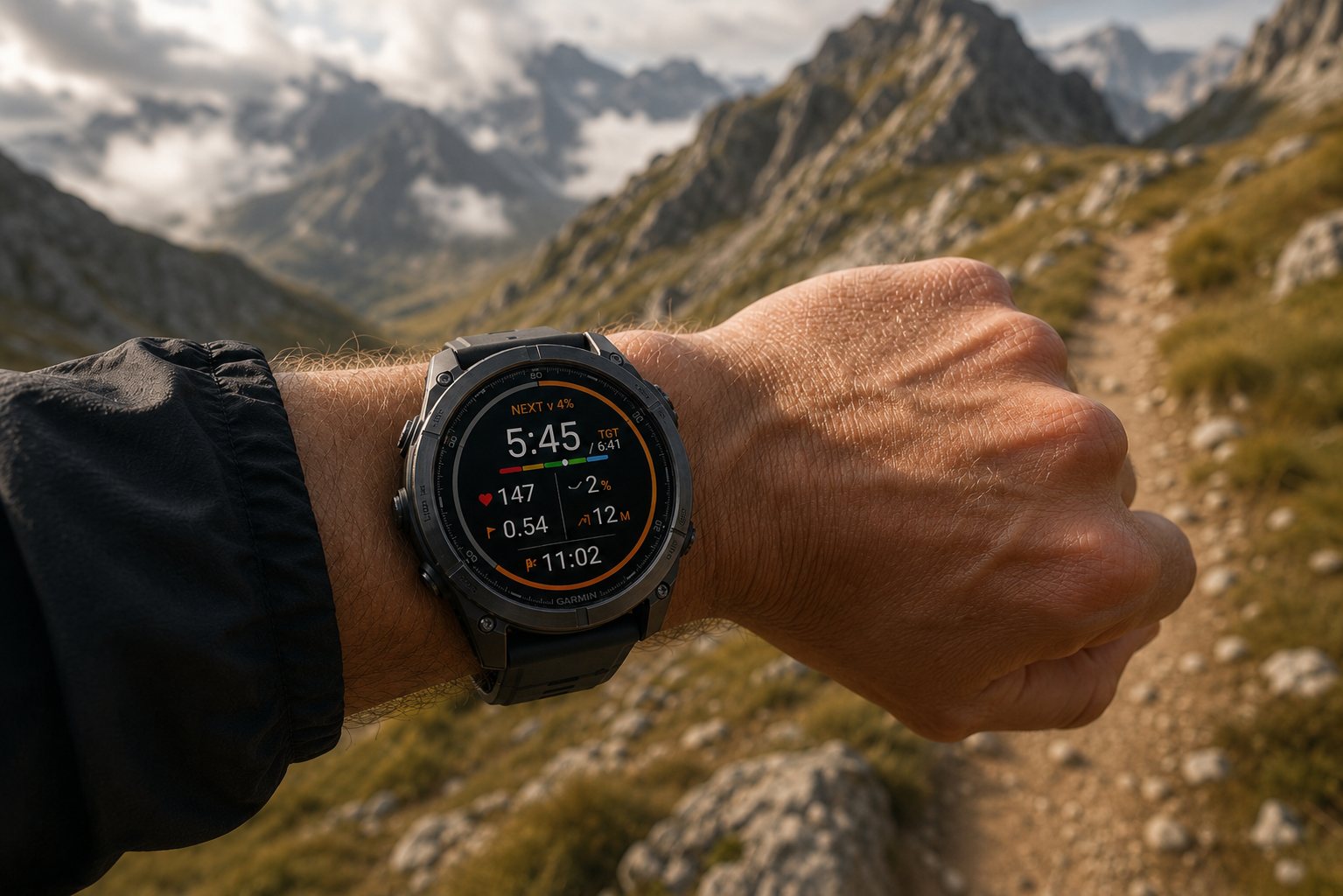
In road running, this luxury became standard long ago. On trail, this kind of structure can be especially useful: the race is usually longer, there are more decisions and more uncertain factors, and you have to handle them in a far rougher state.
05Where to start
Start with your race's elevation profile. Cut it into climbs and descents. For each one, work out what pace to run and where to run versus hike. Add in your stops. Add it all up — and look at the finish time without any illusions, while it's still free to do so.
You can do this in a spreadsheet — genuinely, even a rough calculation is usually more useful than having no reference point at all, as long as you can still adjust the plan by feel during the race. Or you can upload your GPX track to Pacevine: it will automatically split the course into segments and work out an estimated pace for each one, based on grade, surface, and accumulated fatigue. You can then adjust that forecast by hand, factoring in your own experience on climbs, descents, technical sections, and at aid stations.
The mountains won't get any easier. But you'll start with a lot less uncertainty.
Build your race's pacing plan
Upload a GPX — segments, per-segment pace, and aid-station times in under a minute
Sources
- Minetti A.E., Moia C., Roi G.S., Susta D., Ferretti G. Energy cost of walking and running at extreme uphill and downhill slopes. J Appl Physiol, 2002;93(3):1039–46.
- Hoffman M.D., Fogard K. Factors related to successful completion of a 161-km ultramarathon. Int J Sports Physiol Perform, 2011;6(1):25–37.
- Rochat N., Hauw D., Antonini Philippe R., Crettaz von Roten F., Seifert L. Comparison of vitality states of finishers and withdrawers in trail running. PLOS ONE, 2017;12(3):e0173667.
- Corrion K. et al. Psychosocial factors as predictors of dropout in ultra-trailers. PLOS ONE, 2018;13(11):e0206498.
- Hurdiel R. et al. Combined effects of sleep deprivation and strenuous exercise on cognitive performances during the UTMB. J Sports Sci, 2015;33(7):670–4.