You're running with a training partner. Same 10K times, same training volume, you do your long runs together and suffer through intervals just as much as each other. Judging by your flat-ground results, you seem like a pretty even match.
The climb starts — and they pull away from you easily, calmly, without straining at all.
Two hours later, a long descent begins — and now it's you pulling ahead quickly, while they hobble along behind, babying their quads.
Nothing mysterious happened here: the same course makes different demands on each of you, and the advantage shifts along with the terrain.
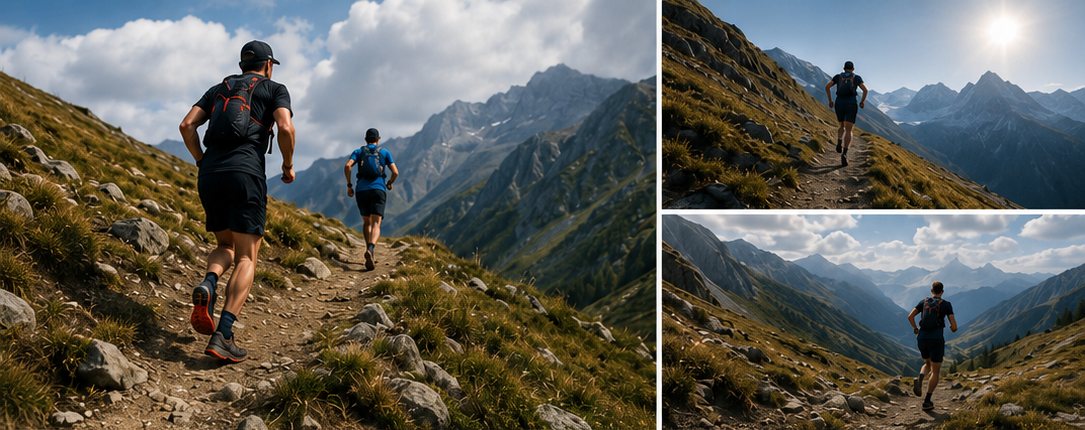
01Climbing: where weight decides
The first factor is body mass. On a climb, you're moving that mass against gravity, so — all else being equal — a lighter runner spends less mechanical work gaining the same elevation. In a small study of amateur vertical-kilometer racers, body mass was indeed one of the factors linked to finish time. But climbing isn't determined by weight alone — relative aerobic power, technique, and the steepness of the slope all matter too.
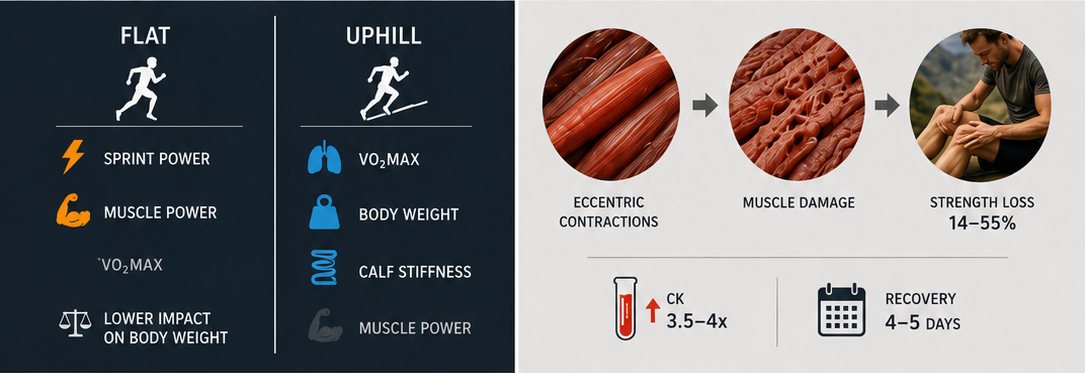
The second factor is less obvious: flat running and climbing demand different qualities. Finnish physiologists compared what predicts speed on level ground versus on a seven-degree climb. In their sample, flat-ground speed was better explained by measures of muscle and anaerobic power, and the researchers found no statistically significant link to VO₂max. On the climb, the picture flipped: VO₂max became the main predictor — though muscle power still mattered there too.
So a strong flat-ground result doesn't guarantee the same edge on a climb: the two modes make different demands on aerobic power, strength, and technique.
A third possible factor is the mechanical properties of the calf muscles, specifically their resting tone as measured by a Myoton device. Together with body mass, this measure explained a significant share of the differences between runners in that sample. What exactly drives it — better force transfer, some quirk of training, or something else entirely — can't be said with any certainty.
And to close out the "just build bigger legs" idea: in this sample, knee-extensor strength was linked to running economy on flat ground and downhill, but not uphill. One sample finding no link doesn't prove there isn't one at all, but quad hypertrophy alone isn't enough to meaningfully improve your climbing.
02Descending: where muscle decides
As we've already covered, descending is cheap, energy-wise. Running on flat ground costs 3.40 joules per kilogram-meter; running down a −20% grade costs just 1.73. Half the price. On a moderate running descent, oxygen usually isn't the main limiting factor.
On a long or steep descent, speed is more often limited by muscle damage and the resulting loss of strength.
Downhill, the quadriceps work largely eccentrically: contracting while simultaneously lengthening, to control knee flexion and absorb the impact of each landing. These are called eccentric contractions, and when the load is unfamiliar and large, they cause noticeably more muscle damage and subsequent strength loss than ordinary flat running.
The numbers are sobering. After one hard downhill effort, knee-extensor strength drops: roughly a quarter in untrained runners, roughly a sixth in trained ones. The literature reports losses ranging from 14 to 55 percent. Blood creatine kinase — a marker of muscle damage — spikes to three-and-a-half to four times normal within a day. Full strength recovery takes four to five days. These exact figures depend heavily on steepness, duration, and training status — they're ranges pulled from different protocols, and any given runner's result can differ.
After a hard descent, the quads simply can't produce as much force — and meanwhile, the race keeps going.
03The repeated-bout effect: why muscles remember
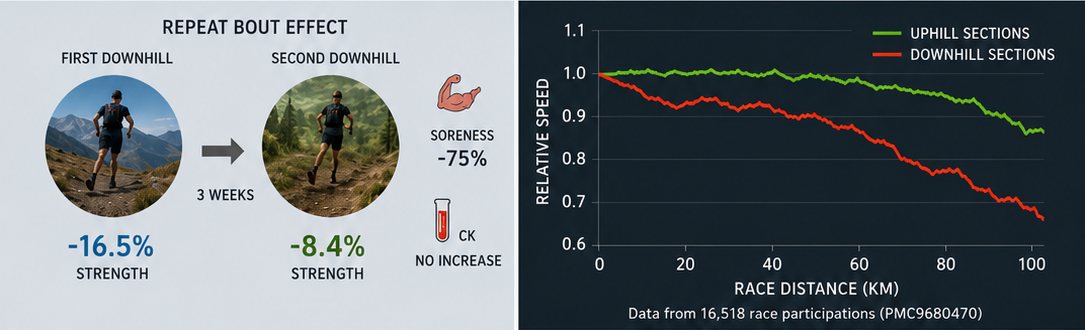
In a small experiment, ten runners ran thirty minutes downhill at a −20% grade. Strength dropped by 16.5%. Three weeks later they repeated the exact same descent, the same thirty minutes. This time strength dropped by only 8.4% — half as much. Muscle soreness fell by roughly three-quarters. And creatine kinase didn't rise at all the second time.
This is called the repeated-bout effect. After a first unfamiliar bout of eccentric loading, the body adapts, so a similar load a few weeks later usually causes less soreness, less damage, and less strength loss — though it doesn't disappear entirely: in this experiment, strength still dropped by 8.4%. The protection lasts for weeks: it was still measurable at three, six, and nine weeks out.
The practical takeaway isn't about general endurance — it's about descent-specific preparation.
Descending is a separate skill, and it's trained separately. The best preparation is descending itself — or some other sufficiently specific eccentric load; hill repeats and track intervals don't substitute for it. Even a single prior training session with a sustained descent can reduce muscle damage from a similar load next time. But for a race with two thousand meters of descent, that's not enough: the ability to descend for a long time, technically, still requires regular practice.
There's a caveat we're obligated to mention. Training studies on descending show mixed results: strength gains of 9–24%, but running economy doesn't reliably improve, and in well-trained runners the effect is often absent entirely. Descent-specific training mainly builds the muscles' resilience to eccentric loading. Improvements in running economy don't show up in every study, especially not in already well-trained athletes.
04Why the legs give out on descents, specifically, in an ultra
An analysis of 16,518 results across four ultra-trail races confirms a trend familiar to a lot of racers: in the second half of the distance, speed drops off especially sharply on descents.
This observation comes from finish-line statistics, not a controlled experiment: analysis like this shows exactly where speed drops, but on its own it doesn't prove the mechanism.
Within this dataset, the gap between faster and slower finishers showed up especially strongly on descents: runners who finished further up front held their downhill speed better, and the slowdown in the second half of the race was concentrated on descents, not climbs.
What came almost for free at kilometer twenty gets hard by kilometer eighty. One likely explanation is accumulated fatigue in the knee extensors: the descent remains relatively cheap in terms of oxygen consumption, but strength, coordination, or muscle soreness no longer let you hold the speed.
Add to that: a descent worsens the economy of subsequent flat running by 3–18% immediately, and by 4–7% for up to three days afterward.
The interpretation writes itself, and it runs against a beginner's instinct: early descents deserve just as much pacing discipline as early climbs. An early descent may be relatively easy on your cardiovascular system, but it's expensive for your muscles — and the strength you lose there won't fully come back before the finish.
05A hill isn't just its gradient: roots, rocks, and heat
We've talked about the athlete — now let's talk about the hill itself.
The same 10% grade is a different hill entirely, depending on what's underfoot.
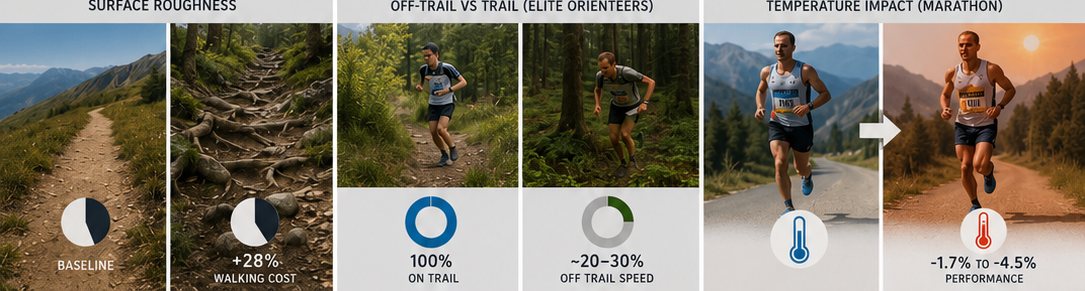
In one experiment, surface unevenness of just two and a half centimeters — meaning simple roots and small rocks, nothing you'd call "technical terrain" — raised the energy cost of walking by 28%. In terms of added energy cost, that uneven stretch was comparable to walking on flat ground at about a 2% grade. For running, the effect was much smaller — around 5%. Why unevenness raised energy cost more for walking than for running can't be pinned down definitively from this data.
And if you leave the trail entirely — even elite orienteers running through forest keep only a fraction of their on-road speed; amateurs lose even more.
Even with an identical course profile, temperature and heat-dissipation conditions change the outcome. In a large marathon analysis, performance worsened as heat rose: for the top men, the gap to the course record grew from about 1.7% in the coolest conditions to 4.5% in the hottest. Slower runners lost even more to the heat. There's much less data on ultras — too many other variables affect thermoregulation there.
06How Pacevine solves the equation with your legs in it
One thing follows from all of this. A universal "pace from gradient" formula doesn't describe you — it describes the average person from a lab.
What describes you is the correction on top of it: whether you're lighter or heavier, whether your strength is high aerobic power, muscular force, or short bursts of intensity, whether you've been running descents recently or last did one a season ago, whether you're on gravel or loose scree.
These studies don't hand us one ready-made formula, but they do help identify the factors worth building into a model. In Pacevine, the baseline cost-of-gradient estimate is adjusted for surface and accumulated fatigue; the size of those adjustments is then checked and calibrated against real-world course data. And where a model simply can't know everything — say, exactly how ready your quads are for descents after this winter — we let you manually adjust the forecast to reflect your own preparation.
The model computes a baseline forecast from the course's parameters, and the athlete adjusts it based on their own experience and current form.
There's also what we honestly don't know. Limb length is linked to running economy — but nearly all of that research was done on flat treadmills, so carrying those results straight over to running on slopes would be methodologically wrong. On a flat marathon, women pace themselves noticeably more evenly than men, but in mountain ultras the largest dataset shows the opposite: elite women fade more than men on descents in the second half. Why — science doesn't yet know. We don't build coefficients on top of that.
When reliable data shows up, we'll update the model and write about it separately.
Build your race's pacing plan
Upload a GPX — segments, per-segment pace, and aid-station times in under a minute
Sources
- Minetti A.E. et al. Energy cost of walking and running at extreme uphill and downhill slopes. J Appl Physiol, 2002;93(3):1039–46. (treadmill, 10 elite mountain runners)
- Paavolainen L., Nummela A., Rusko H. Scand J Med Sci Sports, 2000;10(5):286–91.
- Giovanelli N. et al. Muscle tone and body weight predict uphill race time in amateur trail runners. Front Physiol.
- Bontemps B., Vernillo G. et al. Downhill running: what are the effects and how can we adapt? A narrative review. Sports Medicine, 2020;50(12):2083–2110.
- Downhill sections are crucial for performance in trail running ultramarathons — a pacing strategy analysis. (16,518 entries, PMC9680470)
- Voloshina A., Kuo A., Daley M., Ferris D. J Exp Biol, 2013;216(21):3963–70 (walking) and Voloshina & Ferris, J Exp Biol, 2015;218(5):711–9 (running).
- Ely M., Cheuvront S., Roberts W., Montain S. Impact of weather on marathon-running performance. Med Sci Sports Exerc, 2007.